


What Is Natural Language Query (NLQ)?
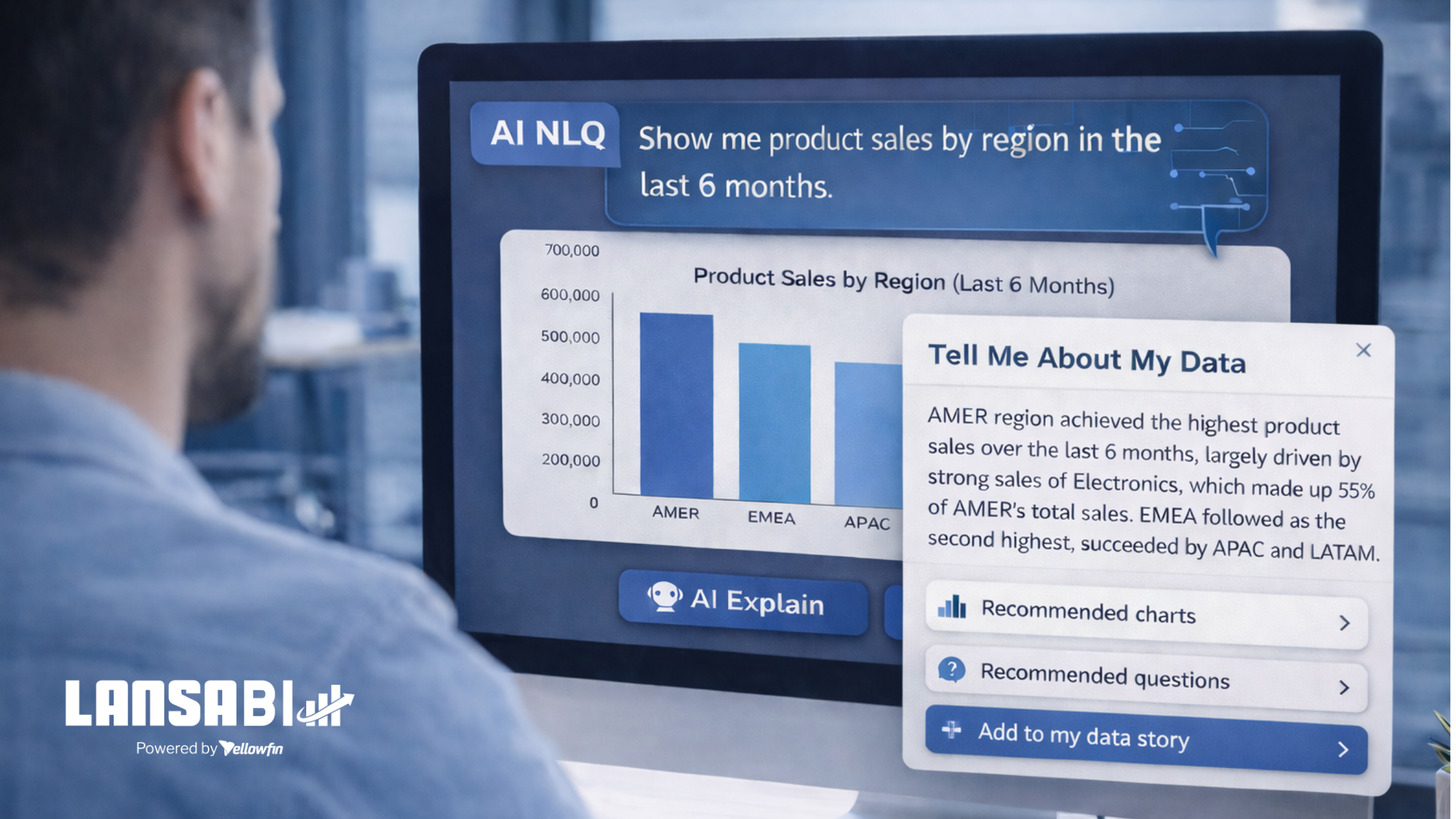
Natural Language Query (NLQ) is a business intelligence technology that allows users to ask questions in simple, everyday language and receive quick insights from their data. Instead of writing SQL (Structured Query Language) or navigating complex dashboards, users can directly type a question like, “Show me monthly revenue trends,” and get immediate answers. As a result, many analytics barriers disappear. Teams can explore data and make decisions with less effort.
Watch how it works: LANSA BI – Natural Language Query – 5 Minute Demo
Today’s NLQ systems are also far more advanced than early keyword-based tools. Thanks to advancements in Artificial Intelligence (AI), Machine Learning (ML), Natural Language Processing (NLP), Natural Language Understanding (NLU), and Large Language Models (LLMs), modern NLQ tools now understand both intent and context, rather than relying solely on exact keywords.[1] Consequently, these systems can interpret complex questions, map them to the right fields, and generate accurate results. Because of these capabilities, NLQ has become a core part of self-service analytics, helping more users work confidently with data.
In addition, Natural Language Queries are now integrated into many BI environments to support everyday tasks, reduce analyst workloads, and expedite reporting cycles. As data ecosystems become increasingly complex, NLQ offers a simpler and more intuitive way for users to interact with large datasets.
Related article: How to Integrate BI into IBM i Applications
Key Insights
- Natural Language Query (NLQ) lets users ask questions about business data in plain language and receive insights without writing SQL queries.
- As data volumes grow and demand for faster decisions rises, NLQ helps teams retrieve insights without waiting for analysts or navigating complex tools.
- Users can ask questions like sales by region or monthly revenue trends and instantly generate charts from enterprise data.
- Reliable NLQ requires clean data, well-structured datasets, and analytics environments users trust for decision-making.
- LANSA BI includes NLQ that can be embedded directly inside operational business applications to deliver insights where work happens.
Benefits of NLQ: Why Is Natural Language Querying Important
Natural Language Querying is important because it removes long-standing barriers that prevent business users from accessing and understanding data. By simplifying how stakeholders interact with analytics systems, NLQ helps organizations move faster, reduce reliance on technical teams, and make data-driven decisions more accessible across the business.
- Enables Self-Service Analytics
Non-technical users can explore data independently without needing to learn SQL or understand complex database structures. This reduces repetitive requests to analysts and IT teams and allows technical resources to focus on more specialized, high-value work. - Expands BI Adoption
Natural Language Query feels familiar because it works like search engines and chat-based programs. This familiarity helps users overcome intimidation and confusion when faced with overwhelming data or complex technology. - Accelerates Insights
Users can review data-backed answers in seconds instead of waiting hours or days for BI reporting. Faster access to information helps decision-makers across departments — including operations, finance, sales, and marketing — respond more quickly to emerging issues or opportunities. These insights support better performance, operational efficiency, customer satisfaction, and competitive agility.
Overall, NLQ helps organizations build a stronger data culture, with employees becoming more confident in using data and applying insights to their daily work.
How Does NLQ Support Business Intelligence
Natural Language Query introduces a simpler way to extract business intelligence. Instead of relying only on predefined dashboards or static reports, users can ask questions and immediately generate visual results from the available data. This allows decision-makers to investigate performance metrics, explore trends, and analyze specific business dimensions such as regions, time periods, or product lines without waiting for new reports to be created.
In AI-powered BI environments, NLQ works alongside automated analytics that continuously analyze data for patterns, anomalies, and emerging trends. When the system identifies unusual activity or notable changes, users can investigate the underlying drivers by asking targeted questions about the data. AI capabilities can also analyze the results of NLQ queries to highlight key contributors, explain changes in performance, or summarize important findings that support faster and more informed decisions.
LANSA BI supports all of these capabilities and allows NLQ to be embedded directly into existing business applications. This enables decision-makers to access data and insights within the systems they already use to manage operations. Visualizations generated from NLQ queries can be added to a business intelligence dashboard to monitor key metrics or incorporated into data stories to provide narrative context around trends.
Related article: How to Get Real-Time Insights with LANSA BI
How Does NLQ Help Analytics Users
Natural Language Querying simplifies several technical steps that traditionally exist between a user and the data they want to analyze. In conventional BI workflows, retrieving an answer often requires locating the correct dataset, selecting the appropriate metrics and dimensions, defining filters, and structuring a query before results can be visualized.[2] NLQ automates much of this process. The system interprets the user’s question, maps the request to the relevant fields in the data model, constructs the query, and returns the results as charts or tables.
For operational users, NLQ removes the need to navigate complex data models or understand how metrics are structured within the analytics system. Instead of selecting measures, defining grouping logic, and configuring filters, users can describe the information they need using business terms. The system translates that request into the underlying query logic and generates the visualization automatically.
For analysts, NLQ simplifies the process of retrieving and validating data during exploratory analysis. Analysts can quickly test questions, review different aggregations, or examine specific segments without manually writing queries or rebuilding visualizations. This allows them to move faster during early stages of analysis and focus their efforts on deeper investigation, modeling, and interpretation.
For executives and decision-makers, NLQ reduces the steps required to access specific performance indicators. Rather than navigating multiple dashboards or requesting new reports, leaders can directly query the data to review metrics, investigate trends, or examine changes across business dimensions.
By automating query construction, metric selection, and visualization generation, NLQ reduces the technical steps involved in accessing business intelligence while still allowing users to interact directly with enterprise data.
What are the Differences Between NLQ, NLP, and NLU?
Although these terms are often used together in discussions about AI-powered analytics, they refer to different technologies that work at different stages of language processing.
Natural Language Processing (NLP) is the broad field of artificial intelligence that enables computers to process and analyze human language. It includes techniques for breaking down text, identifying grammar and sentence structure, recognizing keywords, and processing language input in a way machines can understand. NLP forms the technical foundation for many language-based technologies, including chatbots, translation tools, and voice assistants.
Natural Language Understanding (NLU) is a specialized area within NLP that focuses on interpreting meaning and intent. While NLP processes the structure of language, NLU attempts to determine what the user actually means. It analyzes context, relationships between words, and business terminology to interpret a user’s request accurately. In analytics systems, NLU helps determine which metrics, dimensions, or datasets a user is referring to when asking a questions.
Natural Language Querying (NLQ) applies these technologies within business intelligence systems. It allows users to ask questions about their data using everyday language and receive results from analytics datasets. NLQ relies on NLP to process the language input and NLU to interpret the user’s intent, then translates the request into a structured query that retrieves the appropriate data. In this way, NLQ serves as the user-facing capability that makes conversational data access possible within BI platforms.
Types of Natural Language Queries — What are the Types of NLQ
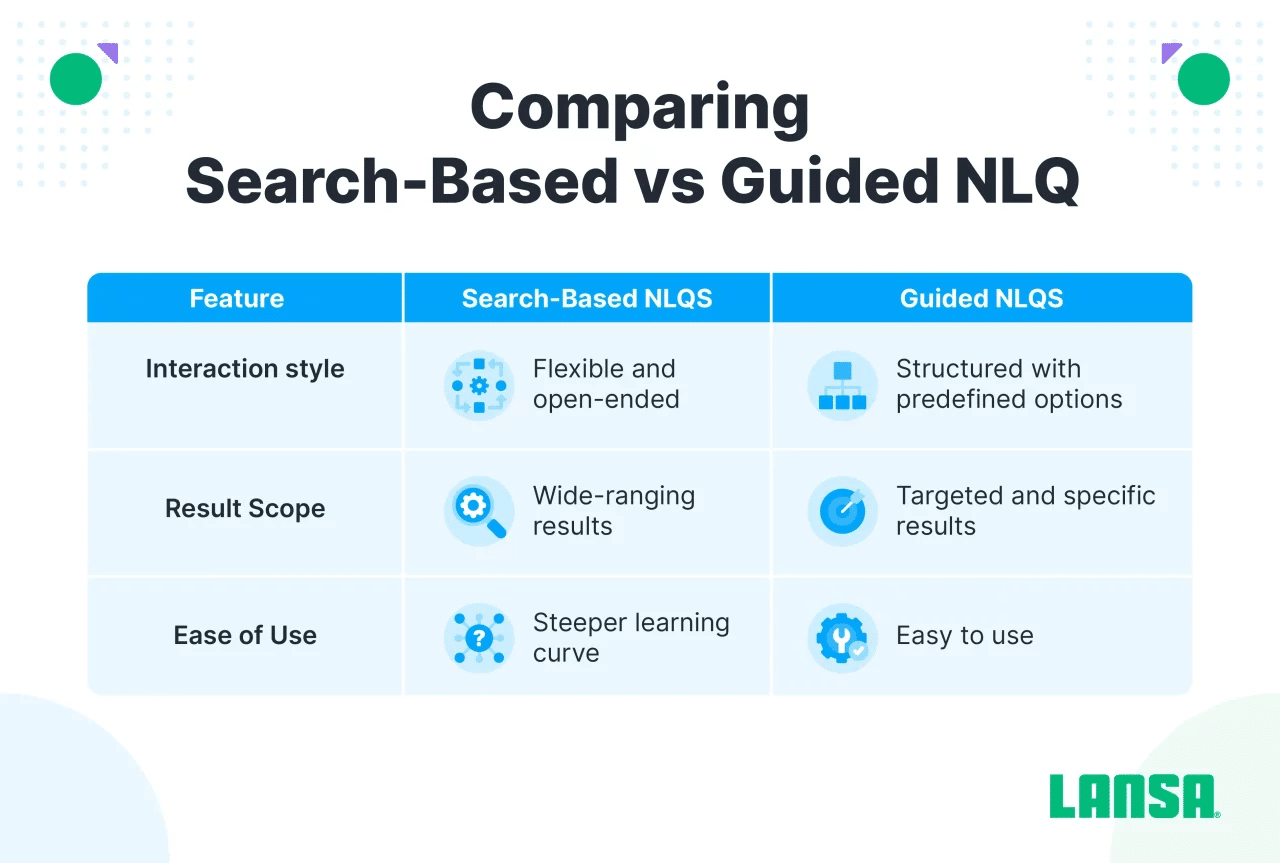
Natural Language Queries can be implemented in several ways, depending on how the BI platform interprets user questions and guides data exploration. The three most common approaches are search-based NLQ, guided NLQ, and AI-driven NLQ.
- Search-Based NLQ – allows users to type questions into a search bar that matches keywords with elements in the underlying database. Many BI platforms include this type of NLQ directly in their user interface, enabling users to enter a question and receive a quick answer based on the available data.However, capabilities vary widely between systems. Some platforms support only a limited set of keywords or data types, while others may restrict the volume or complexity of data that can be queried. In addition, search-based NLQ tools often provide little guidance on how to structure queries, which can make it difficult for users to know what questions the system will understand.
- Guided NLQ – helps users construct more accurate queries by offering structured options that align with the platform’s data model and business rules. Instead of relying entirely on free-text input, the system presents selectable prompts that guide users step by step.For example, a user looking for information about customers in a particular area might begin by selecting “Customers.” The system may then present follow-up options such as “living within,” “onboarded before,” “onboarded after,” or “doing business with us for.” After choosing “living within,” the system may provide additional categories, such as geographic ranges or predefined customer segments. By guiding the query process, this approach helps users ask more precise questions and retrieve relevant insights.
Related article: Extracting Insights with Guided NLQ
- AI-Driven NLQ – uses artificial intelligence to interpret questions written in everyday language. Rather than relying solely on keywords or predefined prompts, the system analyzes the full meaning of the question to determine what the user wants to know. A user can ask a detailed question without understanding how the data is structured, and the system will identify the intent, generate the appropriate query, and return the results automatically. AI-powered NLQ can also recommend follow-up questions, explain results in simple terms, and guide users through deeper data exploration. Because it can interpret longer and more conversational questions, this approach supports a broader range of analytics users—from experienced analysts to occasional business users—while making data exploration more accessible across the organization.
What are Some Examples & Applications of Natural Language Queries?
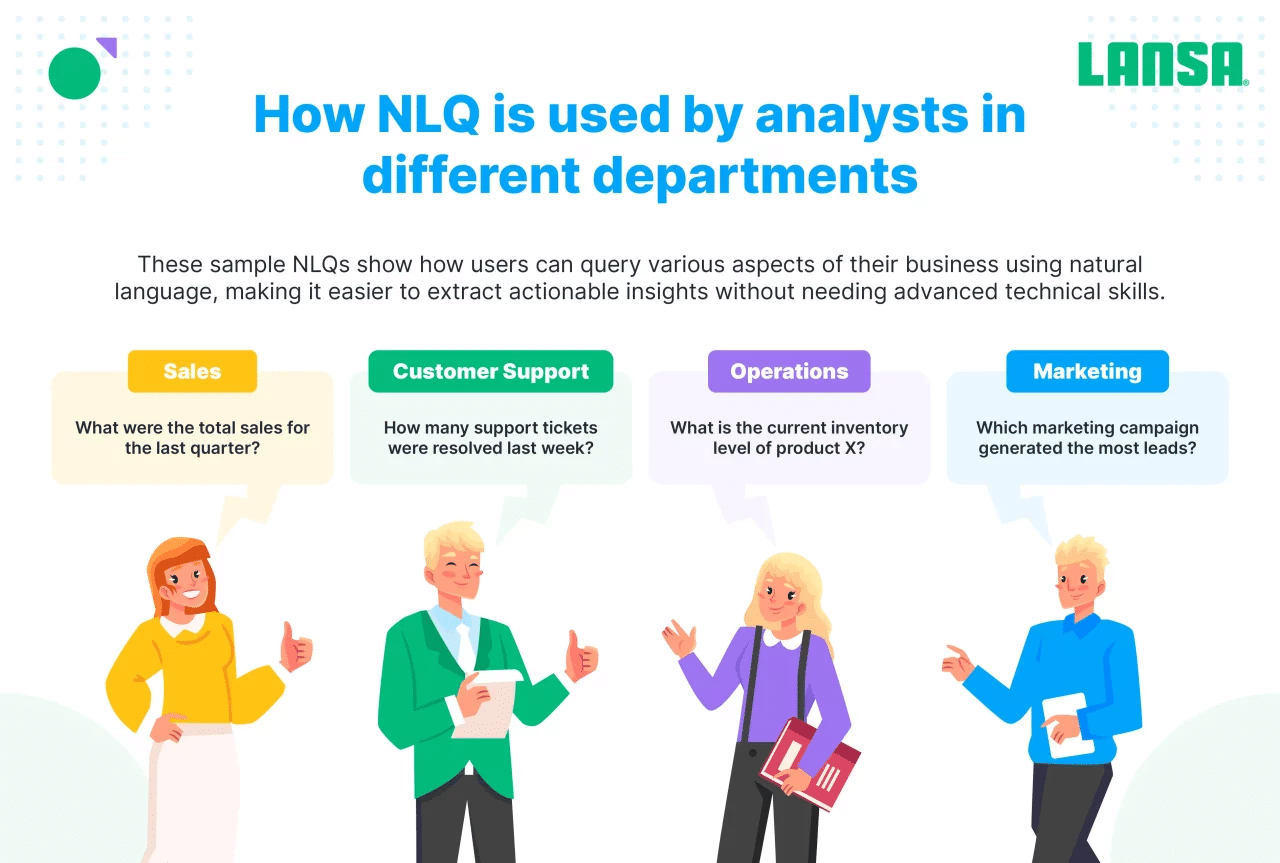
Natural Language Query can support many industries and use cases, including:
Healthcare
In healthcare, clinicians can ask questions like, “Show patient admissions by risk category.” They can also explore trends in length of stay, treatment outcomes, or daily patient volume. With NLQ, they no longer need to open multiple dashboards or run manual reports. Instead, they receive clear answers in seconds, which helps them make faster and more informed decisions about patient care.
Retail
Retail teams can explore purchasing patterns, stock levels, and seasonal trends. They can also check which products sell the fastest, which items are running low, and which promotions perform well. With NLQ, they get these insights without digging through long dashboards. As a result, planning and forecasting improve when data is updated regularly.
Financial Services
In financial services, analysts can spot fraud indicators or review credit risk. With NLQ, they can also check transaction patterns, customer behavior, and unusual account activity in seconds. This gives them faster and clearer insights, which helps speed up risk evaluation processes and strengthens overall compliance.
Manufacturing
Manufacturing teams can track production delays, monitor equipment issues, and review output through simple Natural Language Queries. As a result, they gain quicker visibility into operational performance and can respond to issues before they affect output.
Education Platforms
Education administrators can track enrollment numbers, monitor learning progress, and review performance results with NLQ. This gives them quick access to key metrics without digging through multiple systems or spreadsheets. As a result, they spend less time on manual reporting and more time improving learning outcomes.
The Challenges of Natural Language Query Adoption
While Natural Language Query has advanced significantly, organizations may still face several challenges when adopting the technology.
- Complex Query Handling
Some NLQ systems still struggle with complex or layered questions. When phrasing is unclear or multiple conditions are combined, older tools may misinterpret the request. This can lead to incomplete, misleading, or inaccurate results. - Data Modeling and Storage Limitations
NLQ performs best when the underlying data is clean, structured, and well-modeled. However, many organizations still operate with fragmented datasets or outdated data models. When data structures are inconsistent, the system may return confusing or incorrect answers. As a result, strong data modeling remains a critical requirement for reliable NLQ performance. - Transparency and Trust
Users often want to understand how an NLQ system interpreted their question. When the logic behind the result is not visible, confidence in the output may decrease. Small changes in phrasing can also produce different results, which can create uncertainty for users who rely on the data for decision-making. - User Resistance and Habits
For users who are accustomed to traditional dashboards or manual SQL queries, adopting NLQ can initially feel unfamiliar. However, with proper training and experience, many users recognize that NLQ can accelerate analysis and reduce repetitive reporting tasks.
What is LANSA BI and How Can it Benefit Your Business?
LANSA BI is a business intelligence platform that helps organizations process data, uncover insights, and analyze results for day-to-day operations and decision making. It enables teams to explore business performance, identify trends, and communicate findings through clear visual outputs. The platform includes built-in Natural Language Queries (NLQ), along with interactive dashboards, data stories, assisted insight generation, and BI automation that simplify how insights are generated and shared across the business.
LANSA BI connects to data from a wide range of enterprise systems, allowing organizations to bring information from different sources into a single analytics environment. It also supports embedded analytics within applications, including those running on IBM i, enabling insights to appear directly inside operational systems where work takes place. This flexibility makes the platform suitable for organizations across many industries, whether they are replacing legacy reporting tools with a modern analytics platform or implementing business intelligence capabilities for the first time. LANSA’s BI experts also support customers with legacy report migration and overall analytics delivery to ensure timely and successful implementation.
Related article: JDBC-Based Db2 Integration from LANSA
Final Words
Natural Language Query is changing how organizations interact with their data. By allowing users to ask questions in plain language and receive immediate answers, NLQ removes many of the technical steps that once made analytics difficult to access. As businesses generate larger volumes of data and decision cycles accelerate, tools that simplify data exploration become increasingly important. Platforms that combine NLQ with modern analytics capabilities give teams a practical way to investigate performance, uncover trends, and turn information into action more efficiently.
Organizations interested in exploring these capabilities further can see how NLQ works in practice through LANSA BI. Contact us for a private demonstration or book a free consultation with our experts about your business intelligence requirements.
References
[1] “How does an LLM handle ambiguous or multi-purpose tools? | Milvus.”
https://milvus.io/ai-quick-reference/how-does-an-llm-handle-ambiguous-or-multipurpose-tools
[2] “The Data Warehouse Toolkit: The Definitive Guide to Dimensional Modeling | Ralph Kimball & Margy Ross.”
https://ia801609.us.archive.org/14/items/the-data-warehouse-toolkit-kimball/The%20Data%20Warehouse%20Toolkit%20-%20Kimball.pdf
[3] “Natural Language Processing (Computer Science) | Britannica.”
https://www.britannica.com/technology/natural-language-processing-computer-science
[4] “Natural Language Processing (NLP) | IBM.”
https://www.ibm.com/think/topics/natural-language-processing
[5] “Natural Language Understanding (NLU) | IBM.”
https://www.ibm.com/think/topics/natural-language-understanding